choosing the right partner
By Johanna Stieg
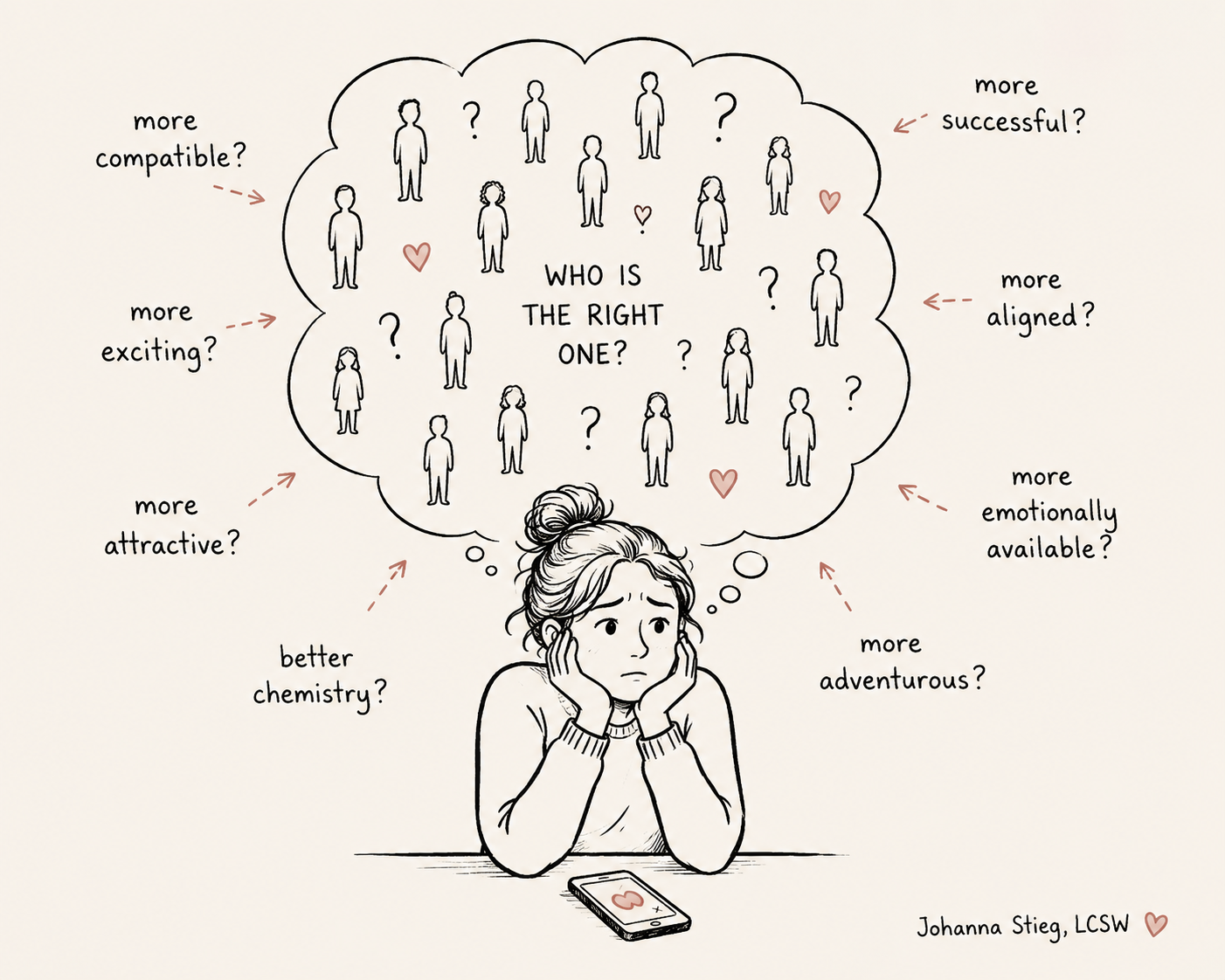
Barry Schwartz’s work on the paradox of choice suggests that an abundance of options can create dissatisfaction and a tendency toward constant comparison. Rather than feeling liberated by choice, people can become "maximizers"—continually searching for the option that might be better. I would suggest that online dating offers us the paradox of infinite choice—and it’s actually deeply unsatisfying.
In their book, Attached, Levine and Heller (2010) describe the “phantom ex” as an avoidant strategy in which someone idealizes a previous partner (or an imagined relationship) in ways that make current partners seem deficient. The phantom ex becomes psychologically "perfect" because they are unavailable and therefore cannot disappoint in the present or be tested in reality.
What if our potential dating partners are falling into the same trap?
The phantom ex is an unavailable person from the past. But what happens when the unavailable person isn't behind us—what if they're always somewhere ahead of us? How many online daters are imagining an “Idealized Future Partner”? The IFP is always potentially more attractive, more compatible, more agreeable, more interesting, and the “right fit.” They are the one who will make us feel certain immediately and never require the discomfort of getting to know another imperfect human being. And they are always just one swipe away.
The IFP has one enormous advantage over the real person sitting across from us: they have never had the opportunity to disappoint us. They never say the wrong thing on a first date. They never reveal awkwardness, insecurity, conflicting needs, or imperfections. The fantasy is appealing not only because this person might be better, but because they allow us to avoid the vulnerability of being known by someone real.
And perhaps that's part of what makes the IFP so powerful. It doesn't just give us someone to imagine; it gives us a way to avoid some of the anxiety that comes with choosing someone real.
The IFP can protect us from three things: choosing, regret, and vulnerability.
Choosing: As long as there might be someone better, we don't have to decide that this person is the person we want to get to know. There is always another profile, another possibility, another first date. We can keep searching rather than risk making the wrong choice.
Regret: Choosing one person necessarily means letting go of other possibilities. And once we choose, we can no longer know what might have happened with the person we didn't choose. The IFP allows us to keep all of those possibilities alive.
Vulnerability: Perhaps most importantly, the IFP cannot disappoint us. They can't reject us, misunderstand us, ask something difficult of us, or discover something about us that makes them or us reconsider ourselves. The real person can. Choosing a real person means allowing ourselves to be known by another imperfect human being.
Real people cannot compete with fantasy because real people require uncertainty. They ask us to tolerate not knowing, to remain curious, and to discover compatibility over time rather than assuming it should announce itself immediately. Getting to know someone and being with someone can be uncomfortable sometimes. There should be uncertainty, but ideally it is accompanied by aligned fundamentals and the capacity to “figure it out” together.
Choosing the real person isn't a recipe for certainty or even guaranteed success. It is a recipe for knowing—knowing the person, knowing the relationship, and eventually knowing whether you want to keep choosing it. We build relationships through many moments of uncertainty and figuring things out. Through rupture and repair. Through coming back because we are committed and trying to do it better next time.
This fantasy of the IFP also fuels one of the more common insecurities I see in my practice: the belief that the right person should create immediate certainty.
The lightning-bolt moment
I work with many people who feel distressed by not knowing exactly how they feel about someone they are dating.
Often, the uncertainty is not actually:
"Do I like this person?"
It is:
"Why don't I know already if I do?"
We seem to have developed an expectation that the right person should create immediate certainty—that, like a bolt of lightning, we should just “feel it” or “just know.”
But many of the questions that matter most cannot be answered immediately:
Can they be responsive to my needs?
Are they kind when stressed?
How will we resolve misunderstandings?
Do they repair moments of disconnection?
Do our lives fit together?
Are they trustworthy and safe?
Can we co-create intimacy together?
Do I like who I am around them?
We simply need more time to experience someone to know.
So how do we navigate the uncertainty of getting to know someone? How do we know when it's worth investing further? When I work with clients who are dating, one of the things I often encourage is simple:
Go on the second date.
Not because every person deserves more chances. Not because we should ignore incompatibility or dismiss our instincts. But because a first date often gives us very limited information. We are meeting a stranger who is likely nervous, performing, and trying to make a good impression. It may not yet tell us what it feels like to actually be with them.
Maybe the goal of a first date isn't to determine whether we've found our person. Maybe it's simply to become curious enough to find out who this person actually is.