Why Do We Keep Looking for Someone Better? The “Idealized Future Partner” and the Myth of Certainty

choosing the right partner

By Johanna Stieg

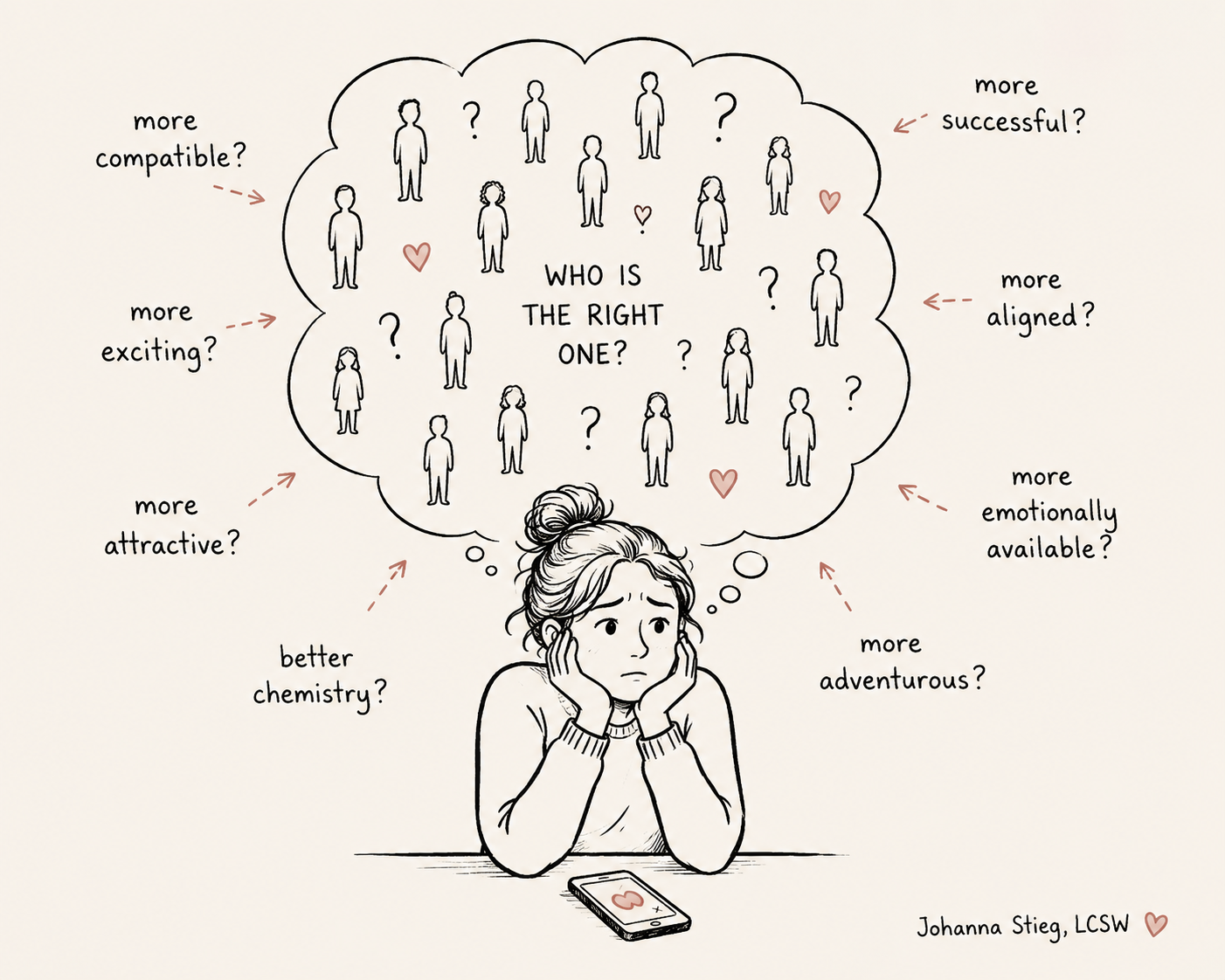
Barry Schwartz’s work on the paradox of choice suggests that an abundance of options can create dissatisfaction and a tendency toward constant comparison. Rather than feeling liberated by choice, people can become "maximizers"—continually searching for the option that might be better. I would suggest that online dating offers us the paradox of infinite choice—and it’s actually deeply unsatisfying. 

In their book, Attached, Levine and Heller (2010) describe the “phantom ex” as an avoidant strategy in which someone idealizes a previous partner (or an imagined relationship) in ways that make current partners seem deficient. The phantom ex becomes psychologically "perfect" because they are unavailable and therefore cannot disappoint in the present or be tested in reality. 

What if our potential dating partners are falling into the same trap?  

The phantom ex is an unavailable person from the past. But what happens when the unavailable person isn't behind us—what if they're always somewhere ahead of us?  How many online daters are imagining an “Idealized Future Partner”? The IFP is always potentially more attractive, more compatible, more agreeable, more interesting, and the “right fit.” They are the one who will make us feel certain immediately and never require the discomfort of getting to know another imperfect human being. And they are always just one swipe away. 

The IFP  has one enormous advantage over the real person sitting across from us: they have never had the opportunity to disappoint us. They never say the wrong thing on a first date. They never reveal awkwardness, insecurity, conflicting needs, or imperfections. The fantasy is appealing not only because this person might be better, but because they allow us to avoid the vulnerability of being known by someone real.

And perhaps that's part of what makes the IFP so powerful. It doesn't just give us someone to imagine; it gives us a way to avoid some of the anxiety that comes with choosing someone real.

The IFP can protect us from three things: choosing, regret, and vulnerability.

Choosing: As long as there might be someone better, we don't have to decide that this person is the person we want to get to know. There is always another profile, another possibility, another first date. We can keep searching rather than risk making the wrong choice.

Regret: Choosing one person necessarily means letting go of other possibilities. And once we choose, we can no longer know what might have happened with the person we didn't choose. The IFP allows us to keep all of those possibilities alive.

Vulnerability: Perhaps most importantly, the IFP cannot disappoint us. They can't reject us, misunderstand us, ask something difficult of us, or discover something about us that makes them or us reconsider ourselves. The real person can. Choosing a real person means allowing ourselves to be known by another imperfect human being. 

Real people cannot compete with fantasy because real people require uncertainty. They ask us to tolerate not knowing, to remain curious, and to discover compatibility over time rather than assuming it should announce itself immediately. Getting to know someone and being with someone can be uncomfortable sometimes. There should be uncertainty, but ideally it is accompanied by aligned fundamentals and the capacity to “figure it out” together. 

Choosing the real person isn't a recipe for certainty or even guaranteed success. It is a recipe for knowing—knowing the person, knowing the relationship, and eventually knowing whether you want to keep choosing it. We build relationships through many moments of uncertainty and figuring things out. Through rupture and repair. Through coming back because we are committed and trying to do it better next time.

This fantasy of the IFP also fuels one of the more common insecurities I see in my practice: the belief that the right person should create immediate certainty.

The lightning-bolt moment

I work with many people who feel distressed by not knowing exactly how they feel about someone they are dating. 

Often, the uncertainty is not actually:

"Do I like this person?"

It is:

"Why don't I know already if I do?"

We seem to have developed an expectation that the right person should create immediate certainty—that, like a bolt of lightning, we should just “feel it” or “just know.”

But many of the questions that matter most cannot be answered immediately:

  • Can they be responsive to my needs?

  • Are they kind when stressed?

  • How will we resolve misunderstandings?

  • Do they repair moments of disconnection?

  • Do our lives fit together?

  • Are they trustworthy and safe?

  • Can we co-create intimacy together?

  • Do I like who I am around them?

We simply need more time to experience someone to know. 

So how do we navigate the uncertainty of getting to know someone? How do we know when it's worth investing further?  When I work with clients who are dating, one of the things I often encourage is simple:

Go on the second date.

Not because every person deserves more chances. Not because we should ignore incompatibility or dismiss our instincts. But because a first date often gives us very limited information. We are meeting a stranger who is likely nervous, performing, and trying to make a good impression. It may not yet tell us what it feels like to actually be with them. 

Maybe the goal of a first date isn't to determine whether we've found our person. Maybe it's simply to become curious enough to find out who this person actually is.
The Rules of Dating Have Changed

Why Modern Dating Asks Us to Decide Before Attraction Has a Chance to Develop


By Johanna Stieg, LCSW

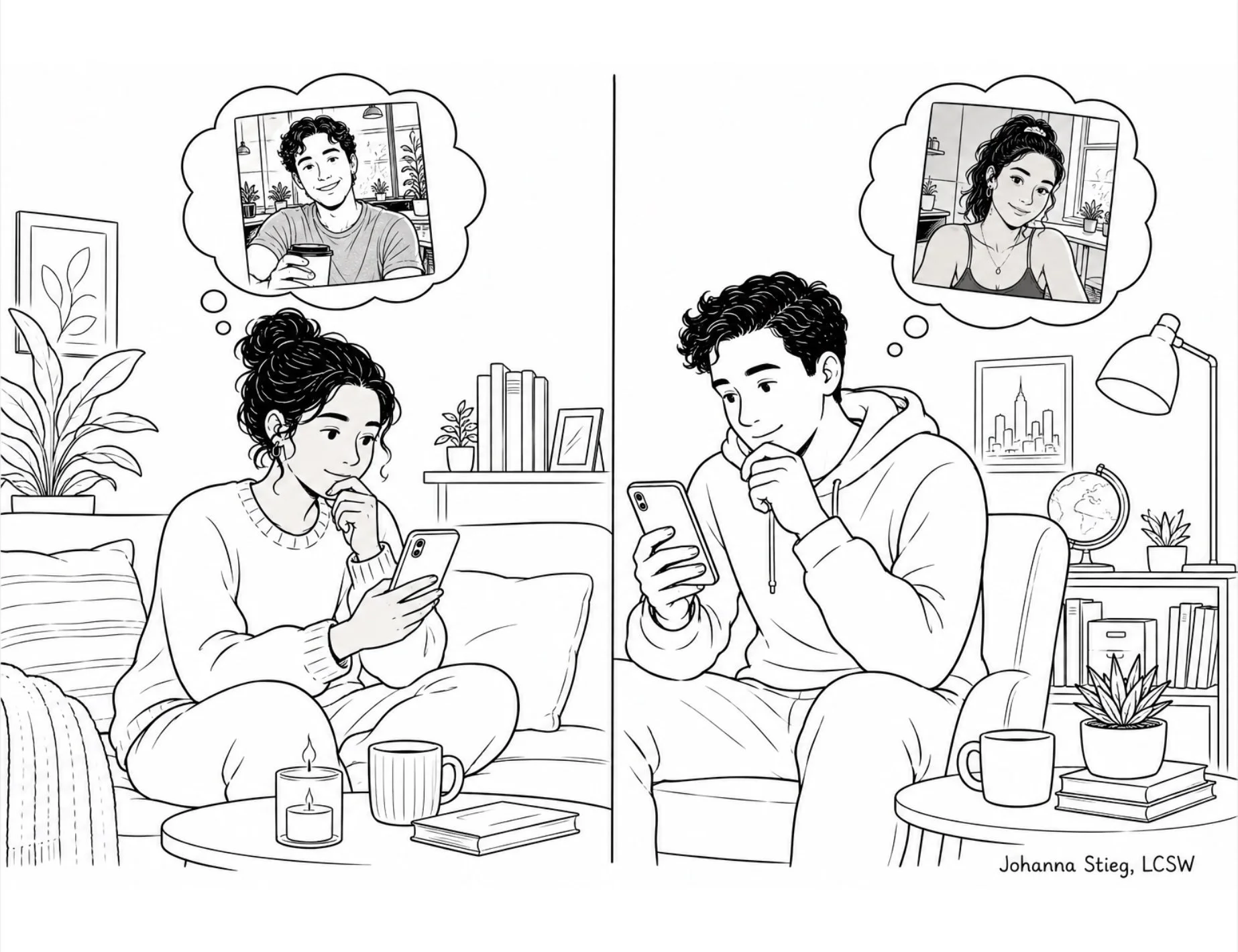
Dating has changed dramatically since modern online dating began in the mid-1990s. We now have access to more potential partners than any previous generation, yet many people I sit with as an individual and couple’s therapist in NYC describe feeling more disconnected, uncertain, and overwhelmed by the process of finding love.

The challenge may not be that we have fewer opportunities, but that we have adapted our expectations to a system that asks us to evaluate potential partners in ways that conflict with how humans have historically developed attraction, trust, and attachment. In adapting to this new model, we may also have  begun to change our expectations around how we should evaluate our attraction to and interest in potential partners. 

Dating apps have shifted the process from one of discovery into a process of evaluation. We are increasingly asked to decide whether someone is a potential partner before we have experienced the very things that create connection: familiarity, emotional responsiveness, shared experiences, humor, body language, and the feeling of who we become when we are with another person.

The question is not whether dating apps are good or bad. The question is whether the way we are using them aligns with how humans actually come to know one another.

Building familiarity matters 

Humans have historically developed relationships in environments where repeated exposure was common. Many people met potential partners through shared communities, neighborhoods, friendships, or social networks. This repeated exposure mattered.

R.B. Zajonc's (1968) mere exposure effect demonstrated that familiarity itself can increase liking and positive feelings toward something—or someone. Simply encountering another person repeatedly creates opportunities for comfort, recognition, and fondness to develop.

I can think of several stories of people who, tired of the apps, reconnected with high school sweethearts, childhood friends, or people from their hometowns. Familiarity provides a foundation from which attraction can grow.

Modern dating environments have changed this process. Instead of repeated exposure to a smaller pool of familiar people, dating apps provide access to an almost endless stream of unfamiliar potential partners.

The benefit is obvious: we can meet people we may never have encountered otherwise. But the psychological tradeoff is that familiarity is no longer built into the process. It must be intentionally created.

We're Missing the Information That Matters Most 

One of the biggest shifts in modern dating isn't simply that we meet online. It's when we're expected to decide whether someone is worth getting to know.

Dating before apps meant attraction more often developed through experience. We met someone, interacted with them, built familiarity, and only then decided whether we wanted to pursue a relationship. Today, that sequence has largely been reversed.

Then:
Meet → Interact → Build familiarity → Attraction develops → Decide

Now:
Evaluate → Compare → Decide → Maybe interact → Maybe develop familiarity

Before we've heard someone's laugh, noticed how they make eye contact, or experienced how we feel in their presence, we're already deciding whether they're worth our time.

This shift matters because attraction is not simply a cognitive process. It is an experiential one.

Research by Eastwick and colleagues (2011) has repeatedly shown that the qualities people believe they want in a partner often fail to predict whom they actually become interested in after meeting face-to-face. Traits that seem essential while scrolling through profiles frequently become less important once two people interact, while qualities people hadn't consciously prioritized—warmth, humor, responsiveness, or conversational ease—become far more influential.

This helps explain one of the central limitations of online dating. As Finkel and colleagues (2012) argue, dating apps are remarkably effective at expanding our access to potential partners, but far less effective at predicting who we will actually connect with. The qualities that make someone a meaningful partner emerge only through interaction. A profile can tell us about someone, but it cannot tell us what it feels like to be with them.

Research on "thin slices" of behavior helps explain why. Ambady and Rosenthal (1992) found that people gather meaningful interpersonal information from remarkably brief observations of another person's expressive behavior. Facial expressions, vocal tone, body language, and timing all contribute to our impressions of warmth, attentiveness, emotional availability, and safety. These are precisely the kinds of cues that disappear when we reduce another person to photographs, prompts, and text messages.  

When I recently asked several people what they found most challenging about dating apps, one woman in her forties told me:

"The only way I've ever successfully started dating someone is by meeting them in person. Dating apps lack any genuine connection, making it incredibly easy to swipe to the next person. In person, I can sense if someone is serious within the first minute or two."

What she's describing isn't magic or intuition. It's the rapid accumulation of interpersonal information that occurs during face-to-face interaction—information that simply isn't available from a profile.

Modern dating encourages us to make decisions using the information that is easiest to display rather than the information that is most predictive of connection. We have become increasingly skilled at evaluating profiles while becoming increasingly removed from the experiences that actually allow attraction to develop.

The goal is not to force attraction where it does not exist. The goal is to give attraction the conditions in which it can develop.

Get beyond the first-date performance. Move past the pressure to immediately know. Allow yourself the opportunity to experience another person rather than simply evaluate them.

In short, modern dating has taught us to search for certainty before we have enough experience to find it. But intimacy has never worked that way. Healthy relationships are built through curiosity, repeated experience, and a willingness to tolerate uncertainty long enough for another person to become known.

A profile can tell you who someone says they are. 

Only experience can tell you what it feels like to be with them.

And that experience—not certainty—is where attraction begins.


References

Ambady, N., & Rosenthal, R. (1992). Thin slices of expressive behavior as predictors of interpersonal consequences: A meta-analysis. Psychological Bulletin, 111(2), 256–274. https://doi.org/10.1037/0033-2909.111.2.256

Eastwick, P. W., Eagly, A. H., Finkel, E. J., & Johnson, S. E. (2011). Implicit and explicit preferences for physical attractiveness in a romantic partner: A double dissociation in predictive validity. Journal of Personality and Social Psychology, 101(5), 993–1011. https://doi.org/10.1037/a0024061


Finkel, E. J., Eastwick, P. W., Karney, B. R., Reis, H. T., & Sprecher, S. (2012). Online dating: A critical analysis from the perspective of psychological science. Psychological Science in the Public Interest, 13(1), 3–66. https://doi.org/10.1177/1529100612436522


Zajonc, R. B. (1968). Attitudinal effects of mere exposure. Journal of Personality and Social Psychology, 9(2, Pt. 2), 1–27. https://doi.org/10.1037/h0025848

“We’ve Talked About This a Thousand Times”: Why Couples Keep Having the Same Fight

By, Johanna Stieg, LCSW

"We've talked about this endlessly."

"We keep having the same conversation and nothing changes."

"I feel like I'm always repeating myself, and they never really hear me."

Sound familiar?

Most couples don't come to therapy because they have dozens of different problems. They come because they have one or two conversations that seem to happen over and over again.

The topic may change—money, chores, sex, parenting, in-laws—but somehow the ending is always the same: hurt feelings, defensiveness, distance, and the painful sense that we're just not getting through to each other.

The good news is that this usually isn't because couples don't know how to communicate. In fact, many couples communicate a lot.

The problem is that once emotions take over, the conversation becomes less about understanding each other and more about protecting ourselves from feeling hurt, rejected, criticized, or misunderstood.

The recurring argument isn't the real problem.

The cycle the couple gets trapped in is.

Looking Beyond the Topic

When conflict begins, it's easy to focus on the content of the argument:

"Who forgot to unload the dishwasher?"

"Why aren't we having sex?"

"Why are you always on your phone?"

But these practical issues are often only the surface of something much deeper.

Underneath many recurring arguments are questions like:

  • Do I matter to you?

  • Can I count on you?

  • Will you understand me when I'm hurting?

  • Am I enough for you?

Once those deeper fears are activated, partners stop listening for meaning and start preparing their defense.

The Fight Beneath the Fight

Imagine a conversation about household chores.

Partner A:
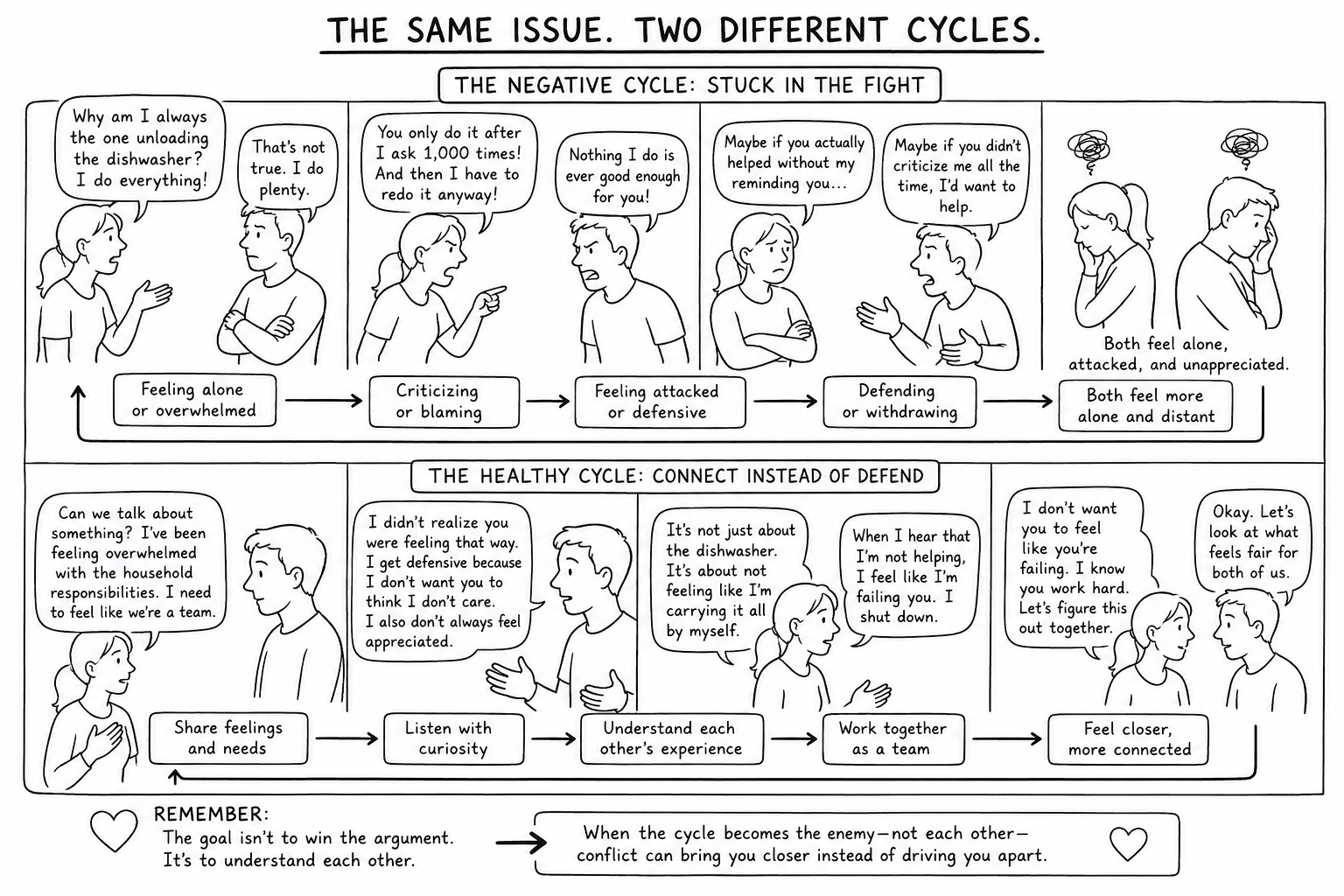
"Why am I always the one unloading the dishwasher? I feel like I'm doing everything around here."

Partner B:
"That's not true. I do plenty."

Partner A:
"Only after I remind you over and over again!"

Partner B:
"Nothing I do is ever good enough for you."

Partner A:
"Maybe if I didn't have to ask all the time..."

Partner B:
"Maybe if you didn't criticize everything I did..."

Sound exhausting?

Notice what happened.

The dishwasher quickly stopped being the issue.

Instead, each partner began reacting to the emotional meaning they assigned to the interaction.

Partner A wasn't simply frustrated about chores.

They were beginning to think:

I'm carrying this relationship by myself. I don't feel supported. I don't feel like my efforts matter.

Partner B wasn't simply arguing about the dishwasher.

They were beginning to think:

I'm failing you. No matter what I do, it will never be enough.

Criticism often isn't simply an attack.

It can be a desperate attempt to be heard.

Likewise, defensiveness isn't always indifference.

It can be an attempt to protect against feelings of shame, failure, or rejection.

The more each partner protects themselves, the less either feels understood.

The cycle feeds itself.

Feeling overwhelmed → criticizing → feeling attacked → defending → both partners feeling increasingly alone and misunderstood.

A Different Conversation

Now imagine the same issue approached from a different place.

Partner A:

"Can we talk about something? Lately I've been feeling overwhelmed by the household responsibilities. When I feel like I'm managing most of it, I start feeling alone. What I really need is to feel like we're a team."

Partner B:

"I didn't realize you were feeling that way. I think I immediately want to defend myself because I don't want you to think I don't care. I also don't always feel appreciated for what I am doing, but I can hear that you're overwhelmed."

Partner A:

"It's really not just about the dishwasher. It's about wanting to feel like we're carrying life together."

Partner B:

"That makes sense. And when I hear that I'm not helping, I immediately feel like I'm failing you. I think I shut down because I feel criticized."

Partner A:

"I don't want you to feel like you're failing. I know how hard you work. I just want us to figure this out together."

Partner B:

"Okay. Let's figure out what would feel fair for both of us."

Notice what changed.

Neither partner gave up their perspective.

The dishes still needed to be done.

But instead of arguing about who was right, they became curious about each other's experience before trying to solve the practical problem.

The conversation shifted from:

"You are the problem."

to

"We have a problem we can solve together."

Listen for the Feeling Beneath the Complaint

Many complaints are actually attempts at connection.

"You never help."

may really mean:

"I feel alone, and I need to know we're in this together."

"You never want sex."

may really mean:

"I miss feeling desired and emotionally close to you."

"You're always on your phone."

may really mean:

"I miss feeling important to you."

Before responding to the words themselves, try asking yourself:

  • What feeling is underneath this complaint?

  • What is my partner hoping I'll understand?

  • What are they longing for that they're having trouble saying directly?

Sometimes that shift in perspective changes the entire conversation.

Why Is This So Hard?

If this sounds easier on paper than it feels at home, you're not alone.

When we're emotionally overwhelmed, our brains naturally shift into self-protection. Instead of becoming more curious, we become more reactive. We listen for criticism instead of connection. We defend ourselves before we've fully understood what our partner is trying to communicate.

This isn't because you're a "bad communicator." It's because conflict often activates our deepest fears about rejection, inadequacy, abandonment, or not being enough.

Learning to recognize those moments—and slow them down—is a skill that takes practice.

When Couples Need Help Interrupting the Cycle

Many couples can identify their pattern once they step back.

They know they're having the same argument.

They know neither of them wants to hurt the other.

Yet in the moment, the emotional intensity pulls them back into familiar roles.

This is where couples therapy can be especially helpful.

Rather than focusing only on the content of the disagreement, therapy helps partners understand the emotional dance they're caught in.

Together we explore questions like:

  • What triggers the cycle?

  • What happens inside each partner when conflict begins?

  • What emotions are hidden beneath the anger, criticism, withdrawal, or defensiveness?

  • What does each partner most need to feel understood, valued, and emotionally safe?

The goal isn't to eliminate conflict. Every relationship has differences.

The goal is to change how partners move through conflict.

The couples who do well aren't the ones who never argue. They're the ones who gradually learn to recognize, interrupt, and repair the cycle that pulls them apart.

Once the cycle becomes the shared enemy—not each other—conflict begins to feel less like a battle to win and more like an opportunity to understand one another more deeply.

If you and your partner find yourselves having the same argument despite your best efforts, couples therapy can help uncover the emotional pattern beneath the conflict and create new ways of responding to one another. The goal isn't simply better communication—it's building a relationship where both partners feel safe enough to be honest, vulnerable, and truly understood.