By, Johanna Stieg, LCSW
"We've talked about this endlessly."
"We keep having the same conversation and nothing changes."
"I feel like I'm always repeating myself, and they never really hear me."
Sound familiar?
Most couples don't come to therapy because they have dozens of different problems. They come because they have one or two conversations that seem to happen over and over again.
The topic may change—money, chores, sex, parenting, in-laws—but somehow the ending is always the same: hurt feelings, defensiveness, distance, and the painful sense that we're just not getting through to each other.
The good news is that this usually isn't because couples don't know how to communicate. In fact, many couples communicate a lot.
The problem is that once emotions take over, the conversation becomes less about understanding each other and more about protecting ourselves from feeling hurt, rejected, criticized, or misunderstood.
The recurring argument isn't the real problem.
The cycle the couple gets trapped in is.
Looking Beyond the Topic
When conflict begins, it's easy to focus on the content of the argument:
"Who forgot to unload the dishwasher?"
"Why aren't we having sex?"
"Why are you always on your phone?"
But these practical issues are often only the surface of something much deeper.
Underneath many recurring arguments are questions like:
Do I matter to you?
Can I count on you?
Will you understand me when I'm hurting?
Am I enough for you?
Once those deeper fears are activated, partners stop listening for meaning and start preparing their defense.
The Fight Beneath the Fight
Imagine a conversation about household chores.
Partner A:
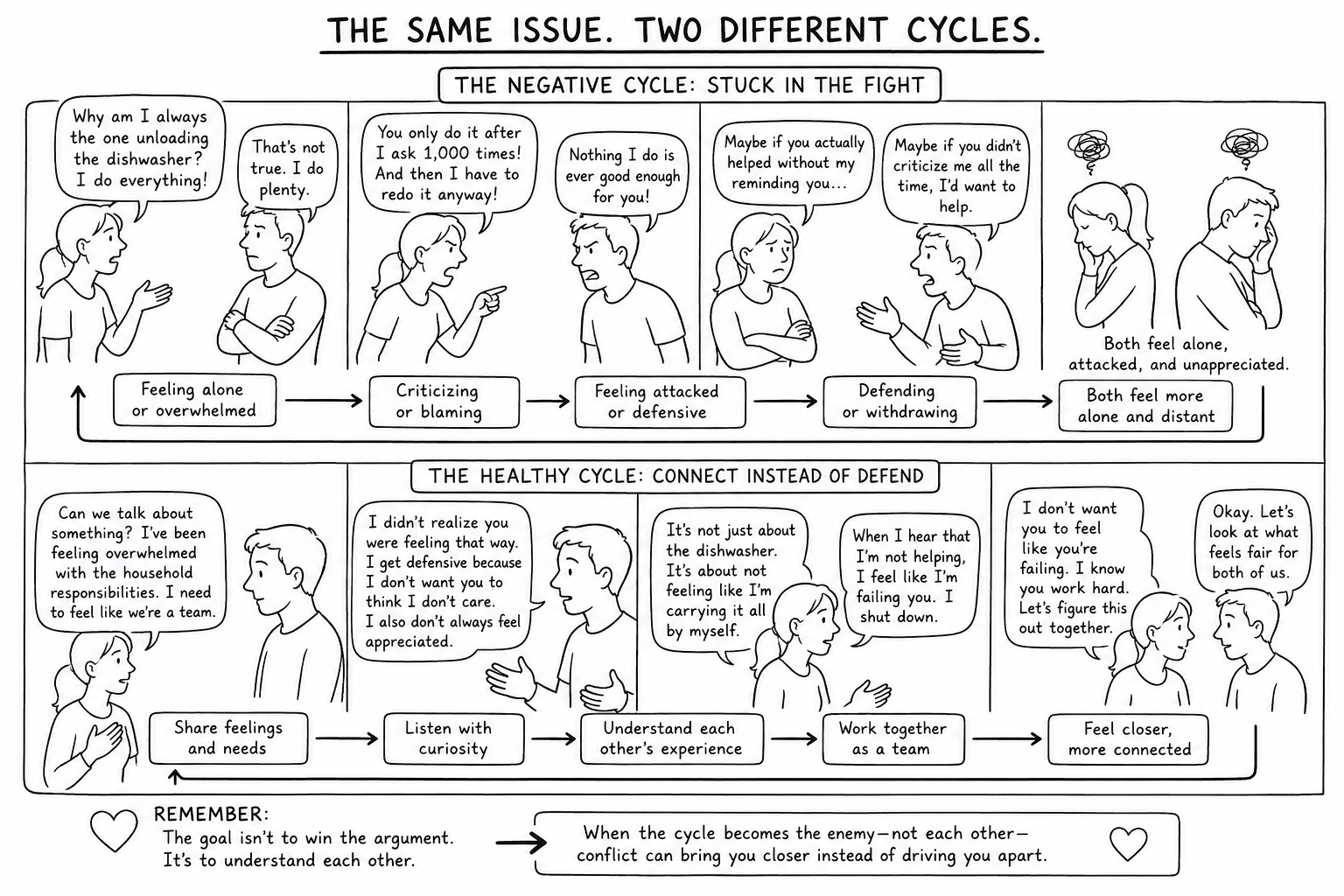
"Why am I always the one unloading the dishwasher? I feel like I'm doing everything around here."
Partner B:
"That's not true. I do plenty."
Partner A:
"Only after I remind you over and over again!"
Partner B:
"Nothing I do is ever good enough for you."
Partner A:
"Maybe if I didn't have to ask all the time..."
Partner B:
"Maybe if you didn't criticize everything I did..."
Sound exhausting?
Notice what happened.
The dishwasher quickly stopped being the issue.
Instead, each partner began reacting to the emotional meaning they assigned to the interaction.
Partner A wasn't simply frustrated about chores.
They were beginning to think:
I'm carrying this relationship by myself. I don't feel supported. I don't feel like my efforts matter.
Partner B wasn't simply arguing about the dishwasher.
They were beginning to think:
I'm failing you. No matter what I do, it will never be enough.
Criticism often isn't simply an attack.
It can be a desperate attempt to be heard.
Likewise, defensiveness isn't always indifference.
It can be an attempt to protect against feelings of shame, failure, or rejection.
The more each partner protects themselves, the less either feels understood.
The cycle feeds itself.
Feeling overwhelmed → criticizing → feeling attacked → defending → both partners feeling increasingly alone and misunderstood.
A Different Conversation
Now imagine the same issue approached from a different place.
Partner A:
"Can we talk about something? Lately I've been feeling overwhelmed by the household responsibilities. When I feel like I'm managing most of it, I start feeling alone. What I really need is to feel like we're a team."
Partner B:
"I didn't realize you were feeling that way. I think I immediately want to defend myself because I don't want you to think I don't care. I also don't always feel appreciated for what I am doing, but I can hear that you're overwhelmed."
Partner A:
"It's really not just about the dishwasher. It's about wanting to feel like we're carrying life together."
Partner B:
"That makes sense. And when I hear that I'm not helping, I immediately feel like I'm failing you. I think I shut down because I feel criticized."
Partner A:
"I don't want you to feel like you're failing. I know how hard you work. I just want us to figure this out together."
Partner B:
"Okay. Let's figure out what would feel fair for both of us."
Notice what changed.
Neither partner gave up their perspective.
The dishes still needed to be done.
But instead of arguing about who was right, they became curious about each other's experience before trying to solve the practical problem.
The conversation shifted from:
"You are the problem."
to
"We have a problem we can solve together."
Listen for the Feeling Beneath the Complaint
Many complaints are actually attempts at connection.
"You never help."
may really mean:
"I feel alone, and I need to know we're in this together."
"You never want sex."
may really mean:
"I miss feeling desired and emotionally close to you."
"You're always on your phone."
may really mean:
"I miss feeling important to you."
Before responding to the words themselves, try asking yourself:
What feeling is underneath this complaint?
What is my partner hoping I'll understand?
What are they longing for that they're having trouble saying directly?
Sometimes that shift in perspective changes the entire conversation.
Why Is This So Hard?
If this sounds easier on paper than it feels at home, you're not alone.
When we're emotionally overwhelmed, our brains naturally shift into self-protection. Instead of becoming more curious, we become more reactive. We listen for criticism instead of connection. We defend ourselves before we've fully understood what our partner is trying to communicate.
This isn't because you're a "bad communicator." It's because conflict often activates our deepest fears about rejection, inadequacy, abandonment, or not being enough.
Learning to recognize those moments—and slow them down—is a skill that takes practice.
When Couples Need Help Interrupting the Cycle
Many couples can identify their pattern once they step back.
They know they're having the same argument.
They know neither of them wants to hurt the other.
Yet in the moment, the emotional intensity pulls them back into familiar roles.
This is where couples therapy can be especially helpful.
Rather than focusing only on the content of the disagreement, therapy helps partners understand the emotional dance they're caught in.
Together we explore questions like:
What triggers the cycle?
What happens inside each partner when conflict begins?
What emotions are hidden beneath the anger, criticism, withdrawal, or defensiveness?
What does each partner most need to feel understood, valued, and emotionally safe?
The goal isn't to eliminate conflict. Every relationship has differences.
The goal is to change how partners move through conflict.
The couples who do well aren't the ones who never argue. They're the ones who gradually learn to recognize, interrupt, and repair the cycle that pulls them apart.
Once the cycle becomes the shared enemy—not each other—conflict begins to feel less like a battle to win and more like an opportunity to understand one another more deeply.
If you and your partner find yourselves having the same argument despite your best efforts, couples therapy can help uncover the emotional pattern beneath the conflict and create new ways of responding to one another. The goal isn't simply better communication—it's building a relationship where both partners feel safe enough to be honest, vulnerable, and truly understood.